How to identify process bottlenecks (and not fix the wrong one)

A bottleneck is the step that limits how much the whole process can produce. Speed up any other step and the output does not change. That is why fixing the wrong one feels like progress and delivers nothing.
The trick is that the bottleneck is rarely the step people complain about loudest. It is the step with work waiting in front of it. Here are five ways to find it, from cheapest to most thorough.
1. Look for the pile
Walk the process and look for where work accumulates: a full inbox, a stack on a desk, a status column with 60 items in "waiting for approval". Work piles up in front of the constraint and thins out after it. Everything downstream of the bottleneck is starved and often looks idle, which is why the people there are sometimes blamed unfairly.
2. Compare touch time with elapsed time
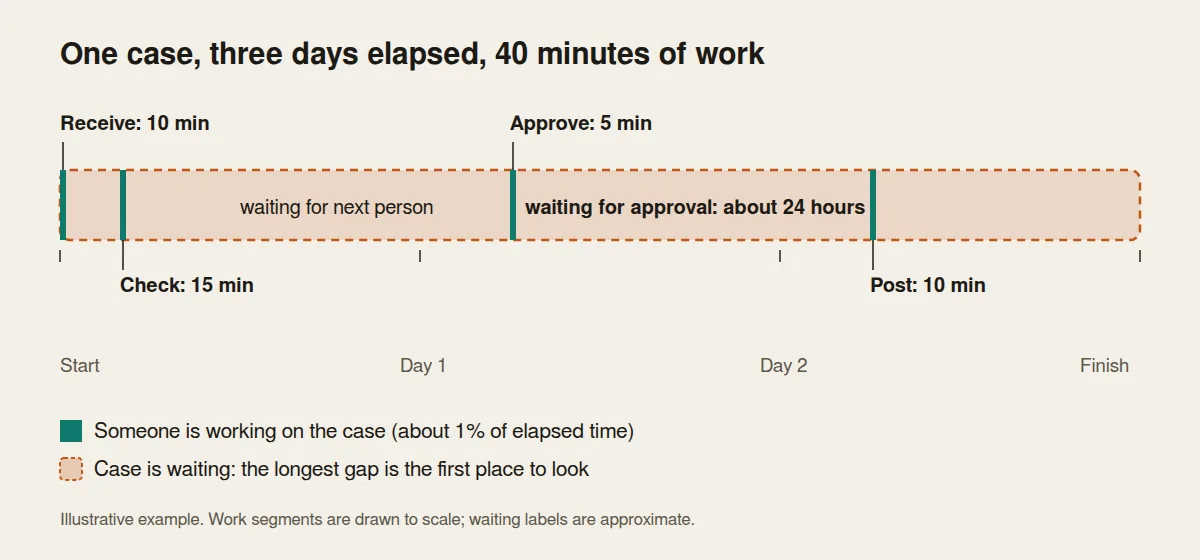
Take ten recent cases. For each, record when it started, when it finished and how many minutes someone actually worked on it. A case with 40 minutes of work and three days of elapsed time is spending almost all its life waiting. Then find where the waiting happens by reading the timestamps at each handoff. The longest gap is your lead candidate.
3. Count work in progress
There is a simple relationship worth knowing, called Little's law: the average number of cases in the process equals the arrival rate multiplied by the average time each case spends there. If 20 cases arrive each day and 100 are open at any moment, the average case takes about five days. If the open count keeps growing, arrivals exceed what the bottleneck can handle, whatever anyone's effort.
Count open cases at each stage once a day for two weeks. The stage that grows is the constraint.
4. Track rework
A step can look slow because it keeps receiving bad input. If an approver rejects 20 percent of invoices, the approval step is not the problem: the coding upstream is. Count how many cases return to an earlier step and where from. Our accounting process map shows exactly this kind of loop.
5. Ask where people wait
Ask each person one question: "What are you waiting for?" Not "what is slow", which produces complaints. People know exactly what they are waiting for, and the answers usually point at the same two or three places.
Check before you fix
| If you see | It probably means |
|---|---|
| Work piles in front of one step, and later steps are quiet | That step is the constraint |
| Everyone is busy but cases still take days | High waiting between steps; look at handoffs |
| One person is overloaded, others have slack | Allocation or skill problem, not capacity |
| A step is slow only on some cases | An exception path hides inside the main path |
| Open cases keep growing week on week | Arrivals exceed the constraint's capacity |
Once you have found it
Work on it in this order. Remove anything that wastes the constraint's time: re-keying, searching for information, handling items that could be handled earlier. Make sure it is never waiting for work. Only then add capacity or automate the step. This follows the logic of the theory of constraints, which says an hour saved at the bottleneck is an hour gained for the whole process, and an hour saved elsewhere is mostly an illusion.
Move the bottleneck and a new one appears elsewhere. That is normal. Re-measure after each change, and stop when the process meets the target, not when it is perfect. If you want help running this on one of your own processes, see our process improvement service.
Related reading and services
Want to fix a process like this?
Book a free process review. Bring one slow process and leave with three improvement ideas.
Book a free review