Process mapping vs process automation: which comes first, and why it matters
The two phrases get used as if they meant the same thing, usually by someone selling one of them. They are different activities with different outputs, and mixing them up is how companies end up with an expensive automation of a process nobody understood.
What each one is
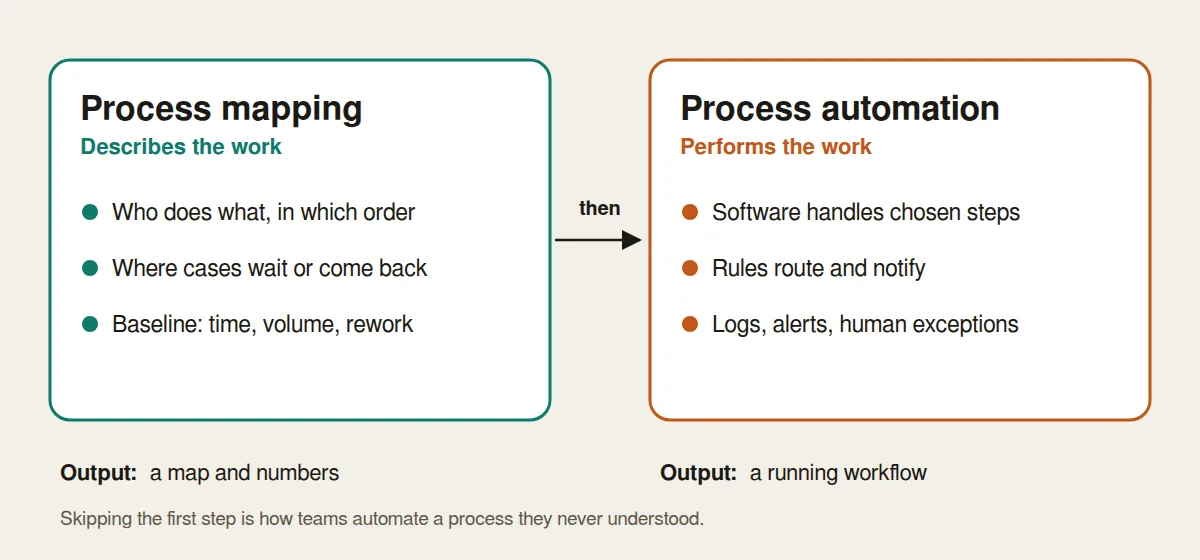
Process mapping describes how work moves: who does what, in which order, with which information, and where it waits. The output is a picture and some numbers. Nothing in the business changes when you finish a map, except what people know.
Process automation makes software perform steps that people or manual scripts perform today. The output is a working system. It changes how the work gets done.
Side by side
| Process mapping | Process automation | |
|---|---|---|
| Question it answers | What really happens? | Who or what should do this step? |
| Output | Map, role table, measurements | Running workflow, logs, alerts |
| Who must be involved | People who do the work | Process owner and whoever maintains the system |
| Typical duration | Days to a few weeks | Weeks, plus ongoing upkeep |
| Risk if skipped | You build on a wrong picture | Nothing improves |
| Risk if done badly | A wrong or out-of-date map | Failures at speed, errors multiplied |
Why mapping goes first
There are three reasons.
You find out what to leave out. In nearly every map there are steps that exist for historical reasons. Automating them preserves them. Removing them is cheaper and often faster.
You find the exceptions. Automation handles the common path easily. The effort is in the exceptions: the invoice with no purchase order, the customer who changes address mid-order. A map made from real cases shows how often these occur and what people do about them. A map made from a procedure document does not.
You get a baseline. To say an automation worked you need the before numbers. Mapping is when you collect them.
A small example
A team receives purchase requests by email and enters them into a system. Someone proposes an automation that reads the email and creates the record. The map shows that a third of requests arrive without a cost centre, and the team spends most of its time emailing back to ask for it. The best change is a request form with a required field. Automation then has little left to do, and the problem is solved at the source.
When mapping alone is enough
Sometimes the map shows the fix. If the answer is "remove the approval for items under a set amount" or "give each handoff an owner", you do not need software. Mapping on its own can pay for itself that way, and that is a good outcome.
When you can skip the formal map
A very small, well-understood task, such as sending a confirmation email after a form is submitted, does not need a swimlane diagram. A rule of thumb: if the process involves more than one person, more than one system, or an exception that happens more than occasionally, map it first.
How we combine them
Our process consulting covers measurement and mapping, and process automation builds from the agreed map. You can buy either one separately. If you want to see what a map looks like in practice, the interactive process maps let you switch between the manual and automated version of the same process.
Related reading and services
Want to fix a process like this?
Book a free process review. Bring one slow process and leave with three improvement ideas.
Book a free review